Unknown's avatar

Posts by ericfridman

I'm the founder of Fridman Associates LLC, an executive coaching firm. I also teach graduate students in the Masters of Science in Learning and Organizational Change program at Northwestern University.

Vocation

In his collection of essays titled “On the Brink of Everything: Grace, Gravity, and Growing Old, Parker Palmer recalls his grandfather, Jesse Palmer, who spent much of his life machining parts for John Deere tractors in Iowa. This was his job, Palmer writes, but his vocation was something more ambitious: “a love of turning raw material into things of use or beauty.” It was a passion his grandfather continued to pursue long after he stopped working for Deere at the mandatory retirement age of 65. 

In the Middle Ages, the word vocation – literally “a calling,” – meant a divine summons to enter the religious life. Today, post-Enlightenment, we usually talk about vocation as work that expresses some unique constellation of our individual talents, interests, and values.

But our limited understanding of what constitutes vocation ignores what distinguishes a true calling from a job or even a career.

Some years ago, I attended a Q&A session between a group of MBA students and the CEO of a Fortune 500 corporation. One of the students asked the CEO how he had managed to maintain work-life balance, given the long hours he’d invested in his career.

The CEO replied, “There’s no such thing as work-life balance. If you don’t believe me, ask my ex-wife.” I could sense an uneasy chill course through the crowd as the students began to absorb the significance of what they had just heard. Underlying the student’s question – and the CEO’s response – was the assumption that “work” and “life” are two parallel lines of human experience that never intersect. Work is about earning a living, and life is about living itself.

As technology continues to blur the boundaries between work and home, especially during the ongoing pandemic, we’re beginning to realize the limitations of drawing such artificial distinctions between life and work – which has led to what’s perhaps the most notable consequence of the pandemic: a reevaluation of personal priorities that’s been called “the great resignation.” 

Many of us are introduced to the idea of vocation in college, since college is the first time most of us are asked to think for ourselves. A lot has been written in recent years on the importance of encouraging college students to approach their undergraduate education as more than just a way to get a job after graduation, and instead to think about college in broader terms, as an exploration of what the idea of a personal vocation might possibly mean for us.  

If we don’t start exploring the meaning of vocation in college, we might start thinking about vocation as the result of some later life-changing event. Nobel Prize-winner Malala Yousafzai discovered her vocation – advocating for girls’ education worldwide – at 15 after being severely wounded by the Taliban in an assassination attempt in 2012.

Far less inspiring was the discovery of my own vocation, which started as a conversation I had with my wife some years ago about how the next chapter of my life might take shape. I confided that after spending most of my career in marketing, I no longer found the work as meaningful as I had in the past. These days, I told her, I find greater significance in helping individuals and teams achieve goals they never believed they could accomplish. So began my transition from marketing executive to executive coach. 

As a student, I’ve always loved school. Today, as a mentor and volunteer, I devote some of my time to advising young professionals and coaching community college students, and I teach graduate students at a local university. And even while I worked for most of my life as a marketer, I did so most recently (and meaningfully) within a university community. Taken together, these different activities point to a single root of inspiration: a love of learning and helping others learn, which I now feel confident defines the core of my life’s vocation.

Any sense of vocation usually includes, at its foundation, the promise of creating some kind of change, large or small, in the world. Jesse Palmer’s vocation celebrated the alchemy of transforming raw materials into something useful or beautiful. The Malala Fund, according to the Nobel website, “empowers girls to achieve their potential and become confident and strong leaders in their own countries.”

So how can you discover what your vocation might be? One piece of advice: don’t limit your investigation to parsing your work history in search of patterns that might emerge. Expand your search to include the totality of your life experience. Start by asking yourself three questions: What activities (including my work) do I find most meaningful and inspiring? What qualities and values do these activities have in common? And finally, what – or whom – do I hope to transform through the sum total of my life’s activities?

Don’t be in a hurry to answer these questions – “live the questions,” as Rainer Maria Rilke encourages us to do with all the great questions in life, until you feel an answer begin to reverberate deeply within your bones. That’s when you can be sure you’re on the path to discovering your true vocation.

Contentment

In a coaching conversation this morning, my client and I were discussing her general lethargy and lack of motivation at work. I’m always learning from my clients, and here’s an insight this morning’s conversation inspired. 

Rather than trying to find a way out of any current malaise and discomfort we might be experiencing in the moment, we might be better off embracing our discomfort as a natural consequence of where we are right now in our lives, rather than struggling to make things other than the way they are.

Byron Katie once observed, wisely, that “when we argue with reality, we lose – but only 100% of the time.” 

If we’re honest, we’ll acknowledge that our lives are 50% heaven and 50% hell, yet we’re constantly bombarded with messages that insist we should be happy all the time – and that if we’re not, something’s wrong. If we convince ourselves that life should be 100% heaven, as advertisers and our social media contacts would like us to believe, our lives quickly become 100% hell. 

It’s simple math. Contentment = reality – expectations. 

Much of our unhappiness is the result of the gap between the way things are and the way we believe things ought to be. If we can close that gap by recognizing that the way things are is exactly the way they should be, our discomfort will start to ease. 

Richard Rohr put it succinctly: “Every expectation is a resentment waiting to happen.” 

None of us has it all together. We’re each a mess, and each of us suffers some degree of psychological distress every day. Acknowledging this truth can help us sidestep the resentment that results when we insist that things be other than the way they are. 

Delegation

Through my work coaching executives, I’ve learned there are four reasons why delegation can be one of the most difficult leadership skills to master. 

First, our view of the world is limited by our own perspective and sense of self. As a result, it’s hard to imagine that anyone else might do the work we’ve asked them to do as well as we might. This is a logical extension of our misimpression that our view of the world is the only accurate view of reality. We might be forgiven for harboring this illusion, since many of us in leadership roles are surrounded by others who spend much of their time nodding in agreement with whatever we say. 

Second, assigning work to someone else to do means giving up some degree of autonomy, a sense of being in control of things. When we feel we’re losing control over events around us – including the quality of work done by those we manage – we feel socially threatened and at risk. Doing the work ourselves helps us feel more secure, even when we suspect that the work might be done better by someone else. 

Third, immersing ourselves in the details of work that might be handled better by others helps us avoid the responsibility of dealing with more strategic concerns, which as leaders is the very work we’re being paid to do. These strategic concerns almost always involve making high-stakes decisions that are central to the future success of our organizations. Focusing our attention on less consequential matters helps us avoid – or at least put off – the risk inherent in making these decisions, the outcomes of which are always uncertain.

Finally, and most important of all, delegation is difficult because it involves asking for help, which is anathema for many leaders. Asking for help forces us to acknowledge that there are certain tasks we can’t do, either because we don’t have the time, knowledge, or skill to do them. Asking for help is one of the most difficult challenges leaders face, because when we ask for help, we reveal that we are not the omnipotent beings we like others to believe we are – much as the “man behind the curtain” revealed the truth of his being to Dorothy in The Wizard of Oz.  

The poet David Whye, in a recent podcast interview with the neuroscientist Sam Harris, tells Harris that he reminds the corporate leadership teams he counsels that “we’re all desperate to be recognized for what we have to offer…and everyone around you is looking for some invitation [to be recognized]. The greatest invitation is for you to say [to those around you] that they have gifts you do not have, and that therefore you need their help. That is the most powerful leadership invitation you can make.”

Ironically, it requires a certain degree of self-confidence to ask someone else for help. When we do, as Whyte points out, we benefit those we ask as well as ourselves. When we ask for help by delegating work to others, we recognize the value they can contribute to our organizations through the help they provide – which is a powerful way of creating loyalty between leaders and those they lead.

The language of silence

This past year I’ve learned a lot about the language of silence. 

When we talk with others about our lives, our minds break down our lived experience into distinct fragments that correspond roughly to different parts of speech. Nouns and verbs mostly, with conjunctions, prepositions, adverbs and adjectives sandwiched in between. We bring the hammer and chisel of language to our world, shattering what was once whole and undifferentiated into shards we can grasp, reflect upon, and discuss with others. 

The more words we use, the more distinctions we create, and by far the most important of these distinctions is the sense of an independent self who lives alone in the world. But this independent self is a mirage created by language. As Ludwig Wittgenstein observed, “the sense of a separate self is only a shadow cast by grammar.” 

Evoking a moment of silence in conversation with others gives us a chance to put all these pieces back together again and return, if only for a moment or two, to the way the world existed and continues to exist before we started thinking and talking about it. Through our silence, we close the distance between ourselves and others by casting a light where once there was shadow.  

One of the few benefits of the ongoing pandemic is that while it has forced us into an extended period of involuntary solitude, it has simultaneously driven home a recognition of the extent to which we depend on each other. We live and work alone but have never felt more of a need to be connected to friends and family. Our relationships to those closest to us have never felt more precious. 

Within this context, silence serves as a language all its own. When we sit in silence with a friend, a family member, a colleague or a client, we communicate humility, vulnerability, and gratitude. We invite our companion to share with us the deepest form of human connection – a bond that exists prior to thought and language. Silence connects us to what we have in common as human beings as opposed to what sets us apart. 

Words distinguish us, while silence unites us. 

Several years ago, while attending a silent retreat, I came across a quote by the late Irish poet and theologian John O’Donohue that the retreat organizers had taped to the door of the meditation hall: 

“One of the tasks of true friendship is to listen compassionately and creatively to the hidden silences. Often secrets are not revealed in words…they lie concealed in the silence between the words or in the depth of what is unsayable between two people.”

As we prepare to rejoin our communities in person, we might use the occasion to reconsider the way we think about silence. We might think about silence not as a lack of communication, interest, or engagement, but instead as a way of communicating with others in those extraordinary moments when there simply are no words – when there’s more to be said than language can convey.

Celebrating boredom

All of humanity’s problems stem from man’s inability to sit quietly in a room alone.” Blaise Pascal, Pensees, 1654

Most of us think of boredom as a kind of moral defect, something to be avoided at all costs. Boredom feels like a cousin to laziness – a malaise that is unproductive and debilitating, especially at work. But what if an occasional encounter with boredom is one of the greatest gifts life can give us?

As schoolchildren we learn a lot about biology, history, and math, but little if anything about how to respond skillfully to those silent invitations to self-awareness, those moments when we find ourselves “sitting quietly in a room alone,” as Pascal puts it. Daniel Goleman has identified self-awareness as the foundation of emotional intelligence, a set of skills essential for personal and professional success. Taking Goleman’s cue, then, I’ve been trying to reframe boredom as life’s way of signaling to me that it’s time to slow down. It’s a chance for me to become more reflective, more self-conscious – in particular, to take note of my habitual striving to measure up to others’ expectations. I now try to view boredom as a chance to catch my breath and imagine how to move my life forward in a way that’s more aligned with my own moral compass.

Easier said than done. Boredom makes me edgy and anxious. That’s because when things get quiet, I find myself forced to confront parts of myself I find distasteful. When I’m working and busy, it’s easy to sweep these unpleasant reminders of my personal failures out of awareness so that I don’t have to deal with the ensuing discomfort. Later, though, when boredom visits, these knots of repressed energy resurface. At this point my habit is to search for some distraction – any distraction – to avoid the anxiety of acknowledging these less than positive facets of my self. Now the challenge is to resist the temptation to pull out my phone, scroll through the news, or check my email as a way of diverting attention away from my boredom – while at the same time, of course, missing a chance for greater insight.

It’s not surprising that some of the most successful, self-aware professionals I know are people who have found ways of celebrating, rather than condemning, moments of boredom in their lives. They relax into, rather than resist, their boredom. They welcome boredom for what it is – a brief time-out, a chance to take stock of where they’ve been and where they’re headed, an opportunity to catch their breath and simply be in the midst of all their doing. They’ve figured out that honoring moments of boredom is a valuable practice that can help them realize the best lives they might imagine for themselves.

Today, working from home in the midst of global health, economic, and social crises, we no longer have the same easy access to many of the distractions we’ve employed in the past to avoid whatever we find distasteful about ourselves. That’s good news, given the urgent need for us to reexamine our own deeply held assumptions about the world in which we live and our relationship with others who live in this same world but are different. Never before has the creativity of the human spirit and honest self-awareness been in such demand and short supply – which is why now is the perfect time for us to rethink our relationship with boredom, and to celebrate boredom as a gift that can bring us closer to ourselves.

Three gifts my dying dog left me

A little over a month ago, our 13-year-old Labradoodle Curly was diagnosed with an aggressive form of leukemia. This unexpected news stunned our family. Already hobbled with arthritis and failing eyesight, Curly’s health deteriorated quickly in the week following his diagnosis. When it became clear that he was suffering beyond what any living creature should be expected to endure, we put an end to his pain with the help of our local vet.

I spent much of our remaining time together carrying Curly up and down the front steps of our house so we could go on short walks, or sitting together in the three-season room that overlooks our backyard when his pain became so intense that it was difficult for him to move. Now that he’s been gone several weeks, I’ve pulled myself together enough to see that through his sudden passing he left me three wonderful gifts, three important reminders about this miraculous experience we call life.

These reminders couldn’t have come at a better time for me.

First, Curly reminded me that nothing lasts, no matter how much we might wish otherwise. Impermanence is a fundamental quality of our experience, yet we insist on preserving the illusion that the world is stable, solid, and reliable. I imagine that’s why some say change is difficult, but that’s not true. Change isn’t difficult or easy – it’s simply the way things are. We make change difficult whenever we dig in our heels and resist its inescapable pull. We seek comfort in the familiar and will do anything we can to make sure we always have ground under our feet.

Our relationships, our jobs, and our health are always at risk. We peer into our laptops and ask friends and coworkers when they think things will return to normal. The answer is that they will never return to normal, if by normal we mean the way things were before the crisis. Of course this won’t be all bad. Many of us are already embracing new models of living and working together – how we teach and learn in school, collaborate with each other at work, and deliver and receive care from our doctors, to name just a few. But our world will never be the same. Literally every form of social interaction is changing and will continue to change, long after the current crisis ends, in ways that are impossible for us to imagine.

Second, Curly reminded me that all of us are suffering in one way or another, even if we can’t always communicate to others exactly why or how we’re suffering. In his final days, Curly obviously couldn’t communicate to me how he was suffering. We humans are no different – often we find it hard to share with others exactly how life hurts us most. Whether it’s the all-too-familiar hum of existential anxiety pulsing just below the surface of our awareness or the more obvious, incapacitating misery of depression, each of us experiences some degree of psychological distress every day. Much of this suffering we bring upon ourselves because we refuse to accept the truth that nothing lasts. We desperately cling to the way things used to be – to what’s safe, secure, and predictable. This obstinacy is a kind of insanity because when we refuse to acknowledge that nothing lasts, we’re refusing to accept reality, which can’t be undone. We live in the past instead of the present. As the writer Byron Katie puts it, “when you argue with reality you lose – but only 100% of the time.”

All of us are struggling to adapt to changes we’ve been forced to accept in our lives these last few weeks. What makes things worse is that we find it hard to share our pain with others because we know or have heard of people we believe are suffering more than we are. Some of us have friends or family members who have been hospitalized or who have died from the virus, and we’re convinced that our own pain can’t compare to what others must be enduring. So we keep quiet and suffer in silence. It’s worth remembering that those who wreak havoc on our organizations and antagonize us at work during this crisis are suffering just like we are, but because managing their pain is beyond their capacity, they unwittingly seek relief by projecting their misery outward on to others. In times like these, our coworkers deserve our compassion more than our anger.

Finally, Curly’s illness and death reminded me that service to others who are suffering is a privilege. I never considered the special care Curly needed in his final days to be a burden or an inconvenience. I’m grateful to have had the chance to look after him – to take him out every two hours, even in the middle of the night, to relieve himself when the Prednisone made him insatiably thirsty; to lift his 70-pound body in and out of the backseat of the car for a drive to the vet; or to prepare special meals for his sensitive stomach, which was upset by the Cytoxan he was taking to slow the ravages of his cancer.

Curly reminded me that service to others is a privilege. I was standing in a long check-out line at the grocery store last week and had plenty of time to notice how on edge shoppers were, wary of anyone in their vicinity who might be carrying the virus. I also noticed, though, a man in his twenties ahead of me allowing an older woman, accompanied by her seven- or eight-year-old granddaughter, to step in front of him in line so she could pay for the two hot bar meals she was buying for lunch. Several days later, I witnessed a middle-aged woman approach the entrance to this same store, only to turn away and walk back to her car when she realized that admission at this early hour was limited to customers over 60.

These were small courtesies but still remarkable, given the preoccupation with self-preservation this virus has forced upon us. While such gestures will never command the same level of attention as the growing number of deaths the media report each day, I still think they’re worth noting. We ignore such small acts of kindness at our peril, because every time we do so, we diminish our humanity by some small measure.

Nothing lasts, everyone is suffering, and it’s our job to relieve as much suffering as we can. This is the gist of the three gifts my good friend and companion left me. If we’re learning anything from this pandemic, it’s that we are all inextricably woven into a social fabric that connects each of us to everyone else. Better to acknowledge this now, before it’s too late.

One question every CMO should ask themselves everyday

Portrait Of Businesswoman In Office Standing By Window

I’ve spent many years working as a marketing executive, and I’ve learned one especially important lesson along the way.

“How can I create more value inside my organization?” is a question those of us who lead marketing organizations should ask ourselves every day. The answers we come up with will extend far beyond how we might better forecast market demand or imagine more creative branding campaigns.

If my goal as marketing professional is to build productive, long-term relationships with customers, it only makes sense to consider how I might build these same kinds of relationships with peers in my own organization. The more effectively I work with others, both within and outside the marketing department, the more effectively I’ll be able to meet the needs of my customers and achieve my organization’s strategic goals.

In their book The Trusted Advisor, David Maister, Charles Green, and Robert Galford identify four qualities — professional credibility, personal reliability, relational intimacy, and service to others — that are essential for any personal relationship built on trust. Just as every successful brand is founded on the trust and loyalty a company earns from its customers, so every healthy, productive personal relationship – whether at home or at work – is based on these same four qualities.

As a coach and former marketing executive, I often find it useful, when coaching other marketing professionals, to structure our work together around the development of these four trust-enhancing qualities. At the start of our engagement, I’ll sometimes ask a client to consider four questions, each of which is based on one of the four elements of The Trusted Advisor’s “trust equation”:

  • What functional skills do I need to develop, not only to excel in my current role, but also to prepare for future roles? Do I have a detailed plan in place to develop these skills? If so, how diligently am I working my plan?
  • What behaviors should I initiate, eliminate, or modify so that I demonstrate I can be relied upon to do what I say I’ll do, and meet my professional obligations when I say I will? Do I have a detailed plan in place to practice these behaviors? If so, how diligently am I working my plan?
  • How can I strengthen my capacity to relate to those with whom I work, not just as one executive to another, but also authentically, as one human being to another? Do I have a detailed plan in place to cultivate this capacity? If so, how diligently am I working my plan?

And finally…

  • What habits should I practice to re-orient my thinking and behavior away from my own wants and needs toward those of my colleagues? Do I have a detailed plan in place to cultivate these habits? If so, how diligently am I working my plan?

The answers my client provides to each of these questions provide valuable guidance on how we should begin our work together, and where the greatest points of leverage lie. No two executives are alike; our individual personalities are the culmination of decades of social conditioning that shape how we relate to others. We each have our own development work to do, and it’s essential that as a coach I appreciate the unique qualities my client brings to our relationship and start from there.

Probably the one question we ask ourselves most often as marketing executives is “How do my company’s products and services create value for our customers?” What’s surprising is how few of us take time to reflect on how we can increase our own value by intentionally building relationships with our organizational peers based on trust – relationships that will make our work more impactful today and that will serve us well, as we progress through our careers, for years to come.

Silence

finger on the lips


Silence connects us directly and immediately with the deepest level of our shared human experience and stands as a profound gesture of recognition and respect. 

When my son was a freshman at his all-boys Catholic high school, he used to entertain us at the dinner table with impersonations of his religion teacher, Ms. Geary. Whenever she got fed up with the rowdy behavior of her students, Ms. Geary would stand in front of her class and, in a barely audible whisper, beg her students to “practice silence.”

I didn’t think about it at the time, but I can now see that “practice silence” is sound advice not just for testerone-charged high-school boys but also for those of us who coach executives. Silence is a powerful communication skill to develop if we’re interested in connecting with other people – in building trusted relationships with our clients, or with anyone, for that matter, for whom we care deeply. That’s because a thoughtfully-timed moment of silence in a high-stakes conversation signals humility, vulnerability, and a genuine desire for community.

We are, as the social psychologist Edgar Schein reminds us in his book Humble Inquiry, a “do and tell” culture. We feel compelled to demonstrate our intelligence, our power, and our authority by sharing everything we know every chance we get. Not surprisingly, we often think of silence as an absence of communication, and we tend to regard people who choose to remain silent as having nothing important to say.

That’s a mistake. Silence is much more than an absence of anything to say – it’s also an effective tool we can use in conversation whenever we sense there’s more to be said than language can convey. Alain Cardon, a master coach who writes frequently on the subject of coaching technique, notes that great coaches use silence strategically to create an empty space, a “vacuum” that “extracts the concerns, motivations, doubts, and ambitions that originate from the deeper recesses of our clients’ souls.” We need tools we can use to draw these secrets out of our clients in a way that is safe, secure, and supportive.

Let’s admit it – we’re fascinated by our clients’ secrets. We’re intrigued by the assumptions and beliefs that prevent them from seeing new possibilities in work and life and keep them from becoming the best versions of themselves they might imagine. It’s important to give our clients every opportunity to allow these secrets to find the light of day so they can be examined, revised and, if necessary, discarded.

Silence, skillfully and deliberately employed, is just the right tool for the job. It conveys our unconditional belief in our clients’ ability to move forward, beyond stuck. Because it transcends language, silence connects us directly and immediately with the deepest level of our shared human experience and stands as a profound gesture of recognition and respect.

To my mind, there are three coaching scenarios in particular in which it’s best to establish and maintain a few moments of silence. These include:

  • whenever our clients are struggling to process new information that is inconsistent and at odds with the way they currently think about the world
  • whenever we sense that we’re about to speak more out a need to demonstrate our own expertise than out of our obligation to facilitate our clients’ understanding, and
  • whenever we start thinking of our clients more as machines that need to be repaired and less as human beings who are capable, resourceful, and courageous…whenever we start to feel the urge to fix our clients’ problems or resolve whatever issue that’s holding them back. In doing so, we absolve them of responsibility for finding their own answers in a way that makes sense for them.

It’s time to reconsider the way we think about silence. We ought to view silence as a powerful tool that allows our clients the space they need to sort things out for themselves, to do the kind of thoughtful work that facilitates learning and growth. Silence also represents an offer of unconditional support. As Alain Cardon notes, when we practice silence with our clients, what we’re really saying to them is “I am here for you. You can go on.”

Synchronicity

[A talk given at the Church of the Holy Comforter in Kenilworth, Illinois on October 29, 2017]

Early one morning back in August I was sitting in my office when I received a text from my friend and your fellow parishioner Tina Harlan. She asked me if I’d be interested in speaking to a group at her church some Sunday on the subject of “thin places,” which she told me was the theme for the coming year’s adult forum talks.

I was stunned when I received this invitation, but not for any reasons you might imagine.

The night before I’d been reading a book by the journalist Krista Tippett entitled Becoming Wise: An Inquiry into the Mystery and Art of Living. In her book, Tippett describes a sabbatical she’d taken to Ireland to complete a writing project she’d been working on. She notes that the rocky seacoast of western Ireland, where she’d settled in to work, is a part of the country that the ancient Celts had believed was teeming with “thin places,” or locations where the veil between the divine and the human becomes completely transparent. I’d never come across this phrase “thin places” before, so you can imagine how surprised I was to receive this invitation.

33457045975_5f6edceda6_h

After receiving Tina’s text  the next morning, I called her to share this remarkable coincidence. I told her I’d be happy to speak, but after we ended our call I realized that I had no idea what I would speak about. Then I understood. I’d talk about synchronicity – which is, after all, how this whole thing got started in the first place.

Synchronistic events, or “meaningful coincidences” like the one I’ve just described, really are wonderful examples of “thin places.” Over the years, I’ve come to understand that the synchronistic events I’ve experienced represent a source of deep spiritual wisdom, wisdom that time and again has provided me with invaluable insight into how to handle some of my most perplexing personal challenges.

I’d like to start out this morning by offering a brief definition and history of “synchronicity.” Then, I’ll provide a couple more examples of synchronistic events I’ve experienced in my own life, and I’ll suggest some ways we can make events like these more accessible and intelligible. Finally, I’d  love to know if any of you have experienced synchronicity and, if so, how you made sense of these encounters.

My aim this morning is not to try to convince you that synchronicity really exists. Some people argue that it doesn’t, that it’s just an illusion created by what psychologists call “confirmation bias,” or the human tendency to pay attention only to those data that confirm our personal view of the world.

Picture1

I’m an empiricist – I believe that everything I need to know in life I can learn through my own experience, even if I can’t always understand or explain my experience logically. Similarly, I believe that only you can decide for yourselves whether synchronistic events are real and whether they have anything of value to offer.

two seaguls synchronicity

The word “synchronicity” literally means “together in time.” One dictionary defines synchronicity as “simultaneous events that appear significantly related but have no discernible causal connection.” The term was coined by the Swiss psychiatrist Carl Jung in the 1930s to describe certain extraordinary experiences he had had while analyzing patients in his Zurich clinic.

Carl Jung in his house's garden sitting and smoking pipe in Knusnacht, Switzerland, 1949 (1)

Jung wrote at least two articles on the subject of synchronicity, which he considered to be an extremely important dimension of human experience. The first, which appeared in 1949, was a foreword to a new English translation of the ancient Chinese oracle The I Ching, or Book of Changes. The second, published in 1952, is an article entitled  “Synchronicity: An Acausal Connecting Principle.” I’m going to return to the I Ching in a few minutes.

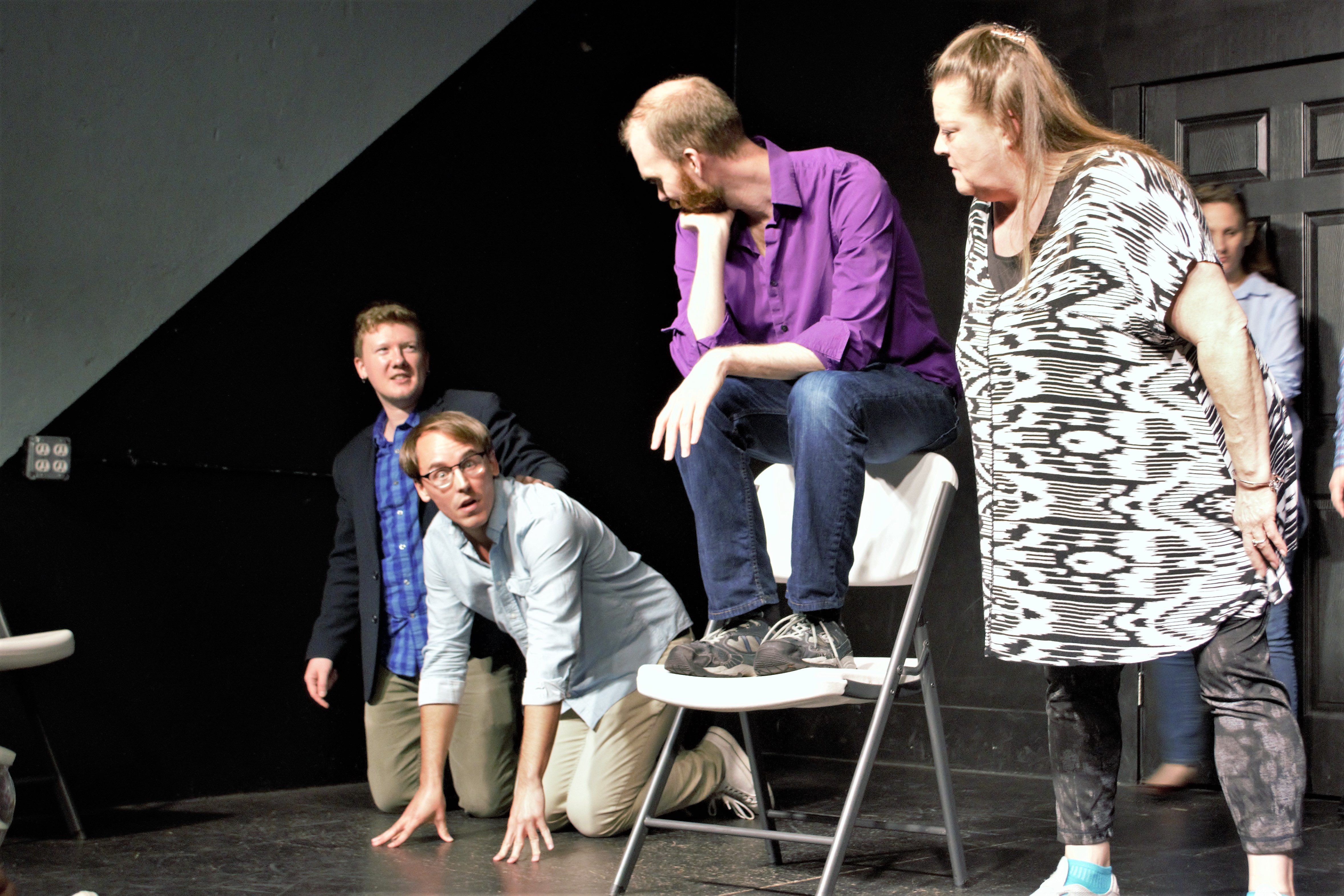
Here’s one way I like to think about synchronicity. I’ve come to believe that our shared human experience is essentially a comedy – a divine comedy, to borrow a title from Dante – and that living our lives with or without the benefit of synchronicity is a little like the difference between performing stand-up comedy and improv comedy.

8009481504_ab5f74efdf_k

Most of the time we live our lives as though we’re performing stand-up. We tell ourselves stories that lead to punchlines that we hope will make us laugh and feel better about ourselves. We imagine a clear line of cause and effect that transports us (we hope) from where we are now to a future where everything will be wonderful and we’ll finally find the peace and contentment we so desperately desire. We’re all about the future, always thinking about getting some place that’s better than where we are now.

Unfortunately, though, the stories we tell ourselves don’t always pan out – the inexorable laws of cause and effect seem to fail us. Things oftentimes don’t go the way we’d hoped, and we end up bitter and resentful because when we get to the end of our story, it turns out that our punchline’s not as funny as we’d hoped it would be.
improv comedy.jpg

This is when we sometimes decide to make an important change in our lives. We decide to begin living our lives as though we were performing improv rather than stand-up.
We stop fantasizing about some ideal future where everything will be perfect, and we begin to appreciate what we have right here, right now, responding on the spot to whatever circumstances present themselves.

At first this transition from stand-up to improv can leave us feeling disoriented and somewhat adrift. Because we’ve left our stories behind and are no longer attached to any particular outcome, it feels like we have nothing left to hold on to. It feels like we have no ground under our feet.

Fortunately, this initial disorientation never lasts very long.  A friend of mine who works in the improv business once told me that she considers every line her stage partner hands her to be a “gift,” an act of grace. And she told me that because she considers every line to be an act of grace, no line can ever be wrong or mistaken.

Gift box in woman's hands on green grass

For those of us who decide to live improvisationally, this is how we begin to think about whatever happens next in our lives. We recognize that what comes next is an act of grace that can never be wrong, regardless of the stories we’ve been telling ourselves about how our lives were supposed to be.

I’ve come to believe that an appreciation for synchronicity is an indispensable part of living improvisationally. Just as there are no mistakes in improv, there are no mistakes in synchronicity.

A synchronistic coincidence, like a great improv line, exhibits a kind of inevitability. As we like to say after the fact, “it was meant to be.” A great improv line perfectly captures the spirit of the moment in which it is spoken –  the mood of the audience, the “gift” our stage partner hands us, even our own intuitive sense of where our skit is headed. Likewise, a synchronistic coincidence perfectly expresses the unique quality of the particular moment in which it occurs. It’s an exponent of all of our worries, fears, hopes and dreams. It’s also a reflection of the all of the conditions that, at this particular moment in time, define the world in which we live – a world that, if we stop to think about it, is really nothing more than our own projection of these same worries, fears, hopes and dreams.

I’d like to share with you a couple more examples of meaningful coincidences I’ve experienced over the years.

The first occurred in 1984, when I was living in Atlanta. I remember the year because it was my first encounter with synchronicity, or at least the first I can remember. I’d decided to buy a house – my first house, to be exact – and I was worried about spending too much money. Buying a house was for me a long, frustrating process — every house I liked I couldn’t afford, and every house I could afford I didn’t much like. This went on for over two months. One night I was venting to a friend, and he suggested – half-jokingly – that we consult his copy of the I Ching about my situation.

i ching 2

I was somewhat familiar with this Chinese oracle – I’d read excerpts in a college class on Asian literature – but I’d largely written if off as a curiosity of pre-scientific civilization. Still, just for fun, we threw the coins. (Just for reference, one consults the I Ching by throwing three coins six times, and the particular combination of heads and tails that turns up directs you to one of 64 hexagrams in the book. Each hexagram describes, in general terms, a different set of circumstances, pronounces judgment on the significance of these circumstances, and offers advice on the best way to work through them.) My six throws directed me to Hexagram #60, which is entitled “Limitation.”

bamboo

I won’t read the whole hexagram, but I do want to read a couple of sentences that appear near the beginning of the narrative. Here’s what they had to say about my situation at the time:

“The Chinese word for limitation really denotes the joints that divide a bamboo stalk. In relation to ordinary life, it means the thrift that sets fixed limits upon expenditures.”

Now, this warning about the importance of not spending beyond one’s means was coincidence enough, given my search for a house to buy, but what happened the following Sunday was nothing short of astonishing.

I was looking at houses with a realtor, and we came to the last house on our list for the day. It was a small, well-preserved 1920s bungalow, and while it needed some minor work, it was within my budget. Here’s a photograph of the house.


657 Yorkshire


backyard bamboo

After walking through the various rooms of the house, we ended up on an outside deck that overlooked a spacious back yard and – to my utter disbelief – a long row of tall, mature, bamboo trees – the first bamboo trees I’d seen in Atlanta, even after living in the city for nearly two years.

The second coincidence I’ll share with you occurred nearly 20 years later, in 2002. I was driving my family from Chicago to Cleveland for my father’s funeral. We were all in the car, my wife and two young children, with my dad’s ashes in a burial urn packed carefully in the trunk.

It had been a challenging week for me, and nothing I did made it any easier for my family. Hovering just overhead were some unpleasant circumstances with estranged family members who were threatening to challenge the legality of my father’s final documents – and I wanted the whole thing to be done with. Not surprisingly, I got pulled over for speeding on the turnpike just east of Toledo by an Ohio state trooper.

Speed Limit 65 - Minimum 45

I tried to explain to the trooper why I was in such a hurry, but he was unimpressed. As he handed me a ticket for a $150 fine – I’d been driving considerably over the speed limit – he gave me a long look heavy with consequence and said, slowly and deliberately, “Son, you need to slow down.”

Now I thought that warning was odd – it sounded jarring to me, given that I was at least ten years older than the state trooper. After we arrived in Cleveland and had checked into our hotel,  I sat down to read through the instructions on the ticket. I noticed the trooper’s signature. His first name was Edmund, which also happened to have been my father’s first name.

The three examples of meaningful coincidences I’ve shared with you this morning were all significant events that would be hard for anyone to miss. Many synchronistic events, though, are less consequential –  a friend you’ve just been thinking about, whom you haven’t seen in years, steps out of a storefront and nearly runs into you on the sidewalk. Or an old song from high school that’s been playing and replaying itself in your head for the last hour or so suddenly comes on the radio.

And then, of course, there are all the meaningful coincidences we never even notice because we’re not paying attention to what’s happening around us. We’re so caught up in our stories, so distracted by all the internal conversations we have with ourselves, that we miss what’s right in front of us.

young woman reflection in rear view mirror

How many of us, for example, have driven home from work, or from a friend’s house or the store, and as we pulled into our garage realized that we had no recollection whatsoever of our drive home?

This begs the question of what, if anything, we can do to become more aware of these kinds of events when they occur in our lives—what we can do to take greater advantage of this wonderful source of unsolicited wisdom.

I don’t believe we can go out and search for synchronicity the same way we might go out and search for the perfect living room rug. In fact, I suspect the opposite is true: the harder we try to find meaning in events around us, the less successful we’ll be. Synchronicity has to find us. It’s an act of grace. Probably the most we can to do is to cultivate the conditions favorable for synchronicity to show its hand. We have to learn how to become attentive and receptive to an entirely new source of wisdom in our lives.

So what can we do to increase the likelihood that synchronicity will speak to us? I have a couple of suggestions.

First, I think it’s important to become and remain aware of whatever pressing questions animate our lives…questions that rise to the surface and beg for our attention in moments of solitude and silence.

8676782437_89e440673c_o

Niels Bohr, winner of the 1922 Nobel Prize in Physics for his work with quantum mechanics, once wrote that “there are two kinds of truth, small truth and great truth. You can recognize a small truth because its opposite is a falsehood. The opposite of a great truth is another truth.” I think the same holds true for questions – there are small questions and great questions. An appropriate response to a small question is typically an answer. An appropriate response to a great question is often times another great question.

The question I posed to the I Ching when I was house hunting in Atlanta was a small question. To be clear about what I wanted to know, I wrote it out on a piece of paper. “How should I go about buying a house?” Small questions tend to be of the moment and usually involve concerns that accumulate on the surface of our lives. Great questions, on the other hand, are profound and hint at concerns that percolate up from the very core of our being.

One of my favorite examples of a great question comes from the Tibetan Buddhist teacher Elizabeth Mattis-Namgyel, who expressed it this way: “How do we live a life we can’t hold on to? How do we live with the fact that the moment we’re born we move closer to death; when we fall in love we sign up for grief? How do we reconcile that gain always ends in loss; gathering, in separation?”

Young woman flying to France

I think it’s telling that we’ve become conditioned in our culture to value answers over questions. For the sake of efficiency, we’ve come to view questions as obstacles to our progress, as problems to be solved as quickly as possible. We might be better served to think of questions – at least great questions – as mysteries to be explored, savored, and lived. One step we can take to become more aware of synchronicity is to pay more attention to asking ourselves the right great questions. Because when everything is said and done, the right answer to the wrong question is not very useful at all.

A second suggestion I’ll make is that we strive to live these great questions – our great questions – in a spirit of what the Franciscan priest Richard Rohr calls “contemplative inquiry.”

Pray with Folded Hands

“Contemplative inquiry” is a way of finding our way through the world that honors the value of both our conditioned need to answer questions quickly and our deep, abiding human desire for spiritual consolation and growth.

As a species we’ve become quite accomplished at the inquiry part of “contemplative inquiry.”  We’re really good at focusing our logical minds on answering whatever questions we encounter in life. At this point in our evolution, though, we might want to devote more time to strengthening our contemplative muscle, to becoming more sensitive to the quality of our inner and outer experience.

To make the most of what synchronicity has to offer us, I think it’s helpful to develop a disciplined, contemplative practice of some kind – prayer, meditation, yoga, or simply walking mindfully in the woods – any activity that expands our capacity to see new things, or to see old things in a new way. Nature walkI’m talking here about cultivating that illusive quality of mind we call “presence.” We’re often reminded that we must be present to win, and I think that’s more true than we’ve ever really imagined.

Shunryu Suzuki, the late founder of the San Francisco Zen Center, described the contemplative mind as a “beginner’s mind.” In his famous book on meditation titled Zen Mind, Beginner’s Mind, Suzuki writes that “In the beginner’s mind there are many possibilities. In the expert’s mind there are few.” Let’s not forget that this is how we learned about the world when we were children. A child doesn’t know what’s possible or impossible and so is entirely open to exploration, experimentation, and discovery.

Montessori Pupil Working At Desk With Wooden Shapes

Now that we’re adults – now that we’ve become experts at life – I fear we’ve become less imaginative about how to seek new knowledge. I think the most important lesson synchronicity can teach us is that our greatest insights often come from where and whom we least expect to find them – the homeless woman sitting on the park bench, the plumber fixing our clogged kitchen drain, or even our surly, next door neighbor who’s never satisfied with the way we cut our grass.

If we can find time to sit in silence for a few minutes each day with a contemplative mind, paying close attention to the world around us and within us, it’s likely we’ll hear a great question calling our name.

Calm man drinking coffee in the morning

“Is it possible that for the last 10 years, I’ve been working in a job that no longer inspires me?” “How well do I really listen to my kids when I get home from work, and what is it that keeps me from truly hearing what they want to tell me?” “What habits in my life might be keeping me from becoming the person I want to become, or perhaps more importantly, from appreciating the person I already am?” Our aim in contemplative inquiry is not so much to find answers to our questions as to allow the answers to find us. This is one way synchronicity can be very helpful.

So these are my two suggestions for how to make synchronicity a greater part our lives. Identify and live the great questions that challenge us to discover a deeper truth. And develop a contemplative practice that helps us cultivate a “beginner’s mind” so that we can see the world with new eyes, in a spirit of childlike curiosity.

But I’m guessing that many of you already know this, so at this point I’ll stop talking. I’m interested in hearing about your own encounters with synchronicity. What did these encounters feel like, and what, if anything, did you learn from from them?

Thank you.

The value of expertise

Musician playing violin isolated on black

Watching the Rio Olympics these last several weeks has gotten me thinking about expertise. Everyone agrees that it’s good to be great at something — traversing the balance beam, speaking a foreign language fluently, or baking a soufflé. What’s less clear is how we become great at something in the first place and why we’re willing to work so hard to do so.

There are two schools of thought about how we acquire expertise. Researchers and brothers Hubert and Stuart Dreyfus contend that when learning a new skill, we pass through five stages of competence, from novice to expert. The novice learns initially through rigid adherence to rules, but over time acquires sufficient skill and judgement to become an expert who responds intuitively to unanticipated challenges that present themselves. The more accomplished we become, the more rules limit the additional learning required to achieve exceptional performance. Understanding context and responding reflexively become key.

In contrast, Swedish psychologist Anders Ericsson dismisses altogether the importance of intuition in becoming an expert. Ericsson, patron saint of piano teachers and personal trainers, insists that the only way to develop expertise is through sustained periods of “deliberate practice” during which one hammers away at improving a desired skill until mastery is achieved. (It is Ericsson’s theory of deliberate practice that led Malcolm Gladwell to attribute to Ericsson — incorrectly, it appears — the “10,000 hours” of practice requirement for becoming an expert.) Ericsson considers expertise based on intuition a form of “arrested development” that encourages complacency, discourages continued learning, and as such represents the greatest single obstacle to becoming an expert.

Regardless of which theory of expertise you subscribe to, it’s clear that becoming accomplished at something involves a lot of work. But what’s the point of it all? What’s the value of expertise?

Becoming an expert at something is, not surprisingly, a great way to make money. Economist Robert Frank, in his recent New York Times op-ed “The Incalculable Value of Finding a Job You Love,” describes research that shows that experts in any line of work capture a disproportionate share of the domain’s total income, since demand for highly-developed skills almost always exceeds supply. We appreciate quality work, whether it’s the fit and finish of a master carpenter’s millwork or the inspired performance of concert violinist, and we’re willing to pay top dollar to enjoy it.

Learning some skill or talent also increases our personal sense of agency, our belief that we can control the chaotic forces at play in what appears to be an increasingly unpredictable world. This perception of being in control of events — illusory though it might be — allows us to feel safe as we navigate through the unexpected challenges life tosses our way. This results, I suspect, from the resilience and hard work required to master any craft and the belief that if we can finish a marathon, we can endure any trial we might encounter.

Finally, becoming an expert at something satisfies a primal desire to grow, to progress, to become stronger or smarter than anyone else and, as a result, survive to tell the story. Striving to do something better than others is a powerful human instinct that in its most basic expression propels the evolution of our species — a species that loves nothing more than winning and keeping score. I offer Michael Phelps as a case in point.

Clearly there are significant economic, psychological, and biological benefits associated with learning and developing expertise. But is there ever a time when expertise becomes a disadvantage, when we’re better off not knowing everything we know? I’ll explore this question in my next post.