Inspiring leaders to live and work with greater awareness, intention, and impact. Kind heart | Fierce mind | Brave spirit
Author /ericfridman
Posts by ericfridman
I'm the founder of Fridman Associates LLC, an executive coaching firm. I also teach graduate students in the Masters of Science in Learning and Organizational Change program at Northwestern University.
It’s easy, but risky, to confuse the work we do with who we are.
When we do, we can find ourselves more concerned with living up to others’ expectations of who we should be instead of engaging in work that’s most meaningful for us.
After one of my clients lost his job and became desolate because of the length of his job search, I suggested he take a pen and piece of paper and complete the sentence beginning with “I am…” as a homework assignment.
He later admitted that this was the most difficult sentence he had ever written. It had taken him two weeks to complete a first draft. Finally, when he read the sentence he had written out loud to himself, he broke into tears.
There was no relationship whatsoever between the jobs he had held for the past 25 years and the sentence he had written on that page.
“What am I longing for?” is a beautiful question Susan Cain, in her book “Bittersweet,” suggests we ask ourselves as a way to discover what’s most important to us in life.
It’s also a great question to ask when we find ourselves feeling adrift after a layoff, or when we voluntarily leave a job after realizing we can no longer work for an abusive boss or a company whose values we no longer share.
This Labor Day weekend, let’s take Cain’s suggestion. Let’s pause for a few minutes and ask ourselves, “What am I longing for?”. It’s a great way to remind ourselves that the work we do should serve who we are and not the other way around.
What was your immediate reaction when you read the title of this post?
Some mild discomfort? A slight twinge of anxiety? A bit of giddy anticipation?
One of my goals as an executive coach is to encourage my clients expand their professional vocabulary. I urge them to consider adding words like “peace,” “contentment,” “joy,” “prosperity,” and “intimacy” to the way they think and talk about the work they do – or would like be doing.
Not words that came up often in my company’s strategic planning retreats back in the day.
But intimacy? Really?
When I first introduce the word “intimacy” into a coaching conversation, my client’s mind immediately goes to physical intimacy, because that’s the paltry, narrow way we’ve become accustomed to thinking about ways of becoming open and honest with others.
Intimacy – the courage to forge close, authentic, personal relationships – is essential for building trust with others, and to drive your career forward, you’ll need the support, encouragement, and trust of your colleagues.
I was never good at math, but one equation I’ll never forget comes from David Maister’s book “The Trusted Advisor”:
Maister goes on to write that people with high intimacy skills “are not afraid to take emotional risks by being open about themselves, for example acknowledging some personal failure or limitation, or being willing to engage in a conversation in which they’re not an expert.”
Here’s one simple suggestion from Warren Berger, author of a remarkable read titled “The Book of Beautiful Questions,” on how to start creating deeper, more intimate relationships with those we work with: ask some “beautiful questions…[questions that] shift your current thinking and open up new possibilities” for relationship.
Forget the lame, habitual question we ask when greeting someone at the start of the day. Stop asking people “how are you?”. Instead, be creative in the questions you ask when greeting others. Here are some examples from Berger’s book you can use:
“What’s the best thing that has happened to you today?”
“What are you excited about in your life right now?”
“What are you most looking forward to at this gathering?”
I would add two more of my own favorites:
“What’s the most annoying thing that’s happened to you this morning?”
“What were you thinking about as you drove [took the train, etc.] to work this morning that you couldn’t stop thinking about?”
Additionally, when you’re meeting someone for the first time, ditch the customary “what do you do?” question. Instead, ask:
“What are you most passionate about?”
“What problem do you wish you could solve?”
“What did you want to be when you were growing up?”
Asking these kinds of questions requires the daring to open ourselves up to possible rejection, even ridicule, but that’s the price we pay for creating the possibility of intimacy. The juice is worth the squeeze.
When working with certain professionals, I prefer that my practitioners have gray hair. Included on this list are airline pilots, neurosurgeons, lawyers, psychotherapists, CEOs, and football coaches (yes, you read that right).
It doesn’t matter if they’re male, female, or identify as neither or both. I simply feel better if they have some gray hair on their head.
So what’s at the root of my obsession with gray hair?
The Nobel Prize-winning quantum physicist Niels Bohr observed that “there are two kinds of truth – small truths and great truths. You can recognize a small truth because its opposite is a falsehood. The opposite of a great truth is another truth.”
That’s why an atom can behave as both a particle and a wave at exactly the same time.
The primary form through which life’s most profound truths express themselves is paradox. Gray hair is nature’s way of reminding us that the world is never simply black or white but always shows up as some particular shade of gray.
Such insight can come to us in our 20s, 30s, or 40s, of course, but far more often this wisdom reveals itself only after we’re well into our 50s, 60s, or 70s.
Skillful leaders learn to thrive within the tension between opposing truths. This capacity enables them to exercise wise judgement and generate solutions that are truly creative.
Rather than giving in to the quick, easy fix of compromise, successful leaders soon learn the importance of doubling down and working harder to discover some third truth that transcends the obvious compromise.
“We lose the benefit of the unique ideas at the two poles when we compromise for middle ground,” writes author Peter Block. “The best outcomes emerge in the effort to understand the truth in both sides.”
It’s painful – not to mention futile – to see the world simply as black or white, which is why I’ve come to so appreciate those of us who have lived long enough to sport some gray hair. Viewing our or another’s take on the world as right or wrong, informed or uninformed, or progressive or reactionary limits our understanding of the world’s complexity and, ultimately, impoverishes our lives in ways too numerous to count.
Here’s a question for you: what’s your favorite question? (This is one of my favorite questions.)
I’m admittedly obsessed with questions, mostly because I know that the right answer to the wrong question is not really an answer at all.
I’ve also come to see that the art of asking the right question, in the right way, at the right time, might be the most undervalued leadership skill of all.
Two books in particular have informed my thinking – and fueled my curiosity – about questions: The Book of Beautiful Questions, by self-described “questionologist” Warren Berger, and Humble Inquiry, by the late organizational psychologist Edgar Schein.
From Warren Berger, I’ve learned that a “beautiful question” is a question that “shift[s] the current thinking, open[s] up new possibilities, and ultimately [leads] to a breakthrough.” Beautiful questions help us grow, make better decisions, think more creatively, build more intimate connections with others, and lead teams more effectively.
Appropriately enough, Berger poses several questions we can ask ourselves to see if we qualify as “beautiful questioners”:
· Am I willing to be seen as naïve? · Am I comfortable raising questions with no immediate answers? · Am I willing to move away from what I know? · Am I open to admitting I might be wrong? · Am I willing to slow down and consider?
From Edgar Schein, I’ve learned the concept of Humble Inquiry, “the fine art of drawing someone out, of asking questions to which you do not already know the answer, of building a relationship based on curiosity and interest in another person.” Schein wisely observes that we live today in a “do-and-tell culture,” in which we feel the need to tell everyone we know everything we know, every chance we get. Working and living in such a culture, it’s easy to lose touch with the fine art of asking thoughtful questions.
The result? Many of the questions we ask turn out to be nothing more than thinly disguised statements seeking validation and confirmation.
Am I right?
Not all questions are meant to be answered, at least not right away. They need time to simmer, like a good stew.
In his Letters to a Young Poet, Rainer Maria Rilke encourages his correspondent, a depressed young Prussian military cadet longing to live the life of a poet, to “love the questions” of life rather than always searching for answers. “Live the questions now,” he writes. “Perhaps you will then gradually, without noticing it, live some distant day into the answer.”
I took Rilke’s advice several years ago and adopted my own question to live into, courtesy of Elizabeth Mattis-Namgel’s slender, beautiful volume The Power of an Open Question.
“’How do we live a life we can’t hold on to? How do we live with the fact that the moment we’re born, we move closer to death; when we fall in love, we sign up for grief? How do we reconcile that gain always ends in loss; gathering, in separation?”
Some years ago, I attended a Q&A session between a group of MBA students and the CEO of a Fortune 500 corporation. One of the students asked the CEO how he had managed to maintain work-life balance, given the long hours he’d invested in his career.
Without hesitation the CEO shot back, “There’s no such thing as work-life balance. If you don’t believe me, ask my ex-wife.”
I could sense an uneasy chill course through the crowd as the students began to absorb the significance of what they had just heard. Underlying the student’s question – and the CEO’s response – was the assumption that “work” and “life” are two parallel lines of human experience that never intersect and are in continual tension with each other. Work is about earning a living, and life is about living itself.
I agree with the CEO. There’s no such thing as work-life balance. As technology continues to blur the boundaries between office and home, we’re starting to realize the limitations of drawing such an artificial distinction between our lives and our work.
Our lives outside of work inform our work, and vice versa. These two domains of our experience are inextricably intertwined. They are one.
Instead of asking, “How can I achieve work-life balance,” we might be better served asking, “How can I achieve work-life alignment? How can I infuse the same sense of purpose that animates my life into the work I do and, as a result, establish a more integrated self?”
The most interesting people I know are those whose lives have been a meander rather than a sprint up and to the right.
They view the world through a larger lens and are better able to see the interconnections between things and how the world we live in is impermanent and always in flux.
They’re interesting because they’ve honored their curiosity and have taken the time to learn about things they didn’t think they needed to know.
This will be a short letter since we’re not permitted to share any personal details about ourselves, although I’d love to tell you all about myself, my family, and my work. It’s also one of the more – if not the most – important letters I’ve ever written. So I’ll keep it really short.
I can’t tell you how much I appreciate the gift of life you’ve given me via your stem cell donation – and how much it has meant to my family and friends as well. Without a stem cell transplant, doctors estimated my life expectancy to be between 2.5 and 3.0 years. If my post-transplant recovery continues as it has to date, there’s no reason to believe I won’t be able to live another 20 years.
You have saved someone’s life. What a wonderful way to give back to a universe that itself gave life to you!
I hope that at the appropriate time we might be able to exchange more personal information and maybe even meet via videoconference. Until then, know that you have already made an extraordinarily positive impact on this world in which we live, which these days desperately needs all the positive impact we can muster.
With the greatest respect, admiration, and appreciation,
I’m not a fan of New Years’ resolutions. When we make a New Year’s resolution, we rarely take into account the powerful, unconscious assumptions we hold about ourselves and the world that anchor us firmly to our habitual behaviors and prevent us from affecting any kind of meaningful, sustainable change.
In the end, New Year’s resolutions turn out to be largely a waste of time. Worse, when we fail to fulfill our resolutions, we end up beating ourselves up and vowing to work even harder next year…and so the self-defeating cycle repeats itself.
We vow to lose weight, but we’re can’t moderate how much we eat during our Sunday extended family dinners. Eating with our family every Sunday has become an important part of how we see ourselves, as defined by our family relationships and as someone who eats, eats, and eats even more – all for the sake of creating and enjoying community with others.
We vow to stop work at 5pm every day to spend more time with our families, but we continue to work late because how we are perceived by others – as someone who works, works, and works even longer for the sake of meeting company objectives – forms an important part of our sense of identity.
We vow to develop a more disciplined meditation practice, but the idea of sitting still, in silence, for 10 minutes a day is inconsistent with our sense of ourselves as someone who pushes, pushes, and pushes even harder – as someone who is always on the move for the sake of getting things done.
To borrow a metaphor from the psychologist Robert Kegan, making a New Year’s resolution is like “having one foot on the gas and one foot on the brake.” We desperately want to make changes in our lives, but our biological and social conditioning holds us back.
Unless we’re willing to undertake the difficult and emotionally charged work of uncovering and examining our unconscious assumptions – one New Year’s resolution I believe is definitely worth making – I recommend a different approach to welcoming the new year.
This year let’s focus less on who we ought to be and more on how we have become who we are. Instead of thinking about all the ways we need to change to become better in the year ahead – which really is a thinly disguised brooding over all the ways we’re falling short today – let’s celebrate how capable and accomplished we already are and have become over the last 12 months.
Starting each new year with a mindset of surplus rather than deficit, of celebration rather than regret, seems to me a healthier, more productive way to grow in the coming months. At least I hope that’s the case, because this time around that’s how I’ve decided to honor the start of the coming new year.
This morning I was sitting in the waiting room of the oncology clinic of a large downtown Chicago hospital, waiting to begin my weekly check-in following my August bone marrow stem cell transplant.
Today, I chose to focus my attention on the very human drama unfolding around me in the waiting room instead of giving into the temptation of distracting myself by scrolling through emails, news bulletins, and social media posts on my cell phone.
After several minutes of listening and observing, I heard a couple checking in at the patient registration desk offer to go downstairs, 21 floors below, and bring the receptionist a bottle of orange juice and a sweet roll.
It’s difficult to describe the flood of gratitude I felt toward this couple for their small, unsolicited act of kindness toward this receptionist. I wouldn’t have wanted to have missed this moment for the world.
We ignore such acts of kindness at our peril, because every time we do, we diminish our humanity by some small measure.
I was reminded that we each have some freedom to choose, moment by moment, the quality of experience we ingest – through the food we eat, the beverages we drink, and how and where we decide to direct our attention. We can always make better or worse choices, with the goal of minimizing the level of toxicity we allow into our lives.
As an executive coach, I’ve read many (probably too many) books on leadership. After a while, they all seem to converge, leading the reader through the same laundry list of presentation skills, catch phrases, and power gestures that promise to show us how to inspire others to work together toward common goals. Looking back some months later, it’s often difficult for me to recall what it was exactly that distinguished any one of these leadership books from the others.
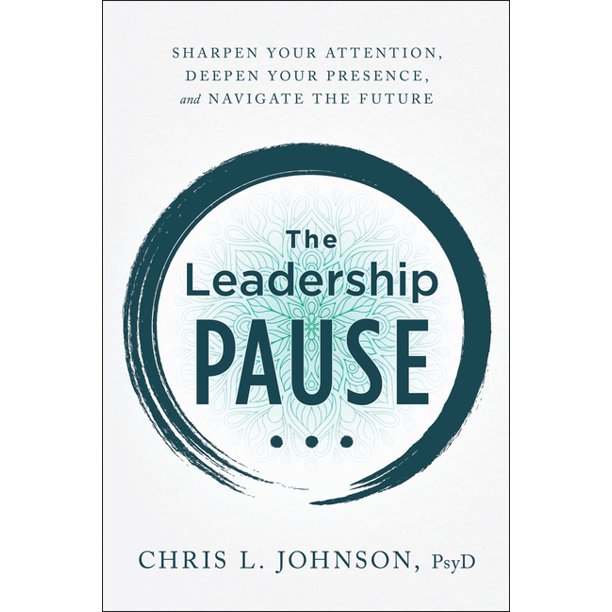
This likely won’t be the case for readers of Dr. Chris Johnson’s The Leadership Pause. Johnson’s counterintuitive argument is that it’s not what you do that makes you an effective leader but rather what you don’t do. If most leadership books are based on the law of addition – do more of this or that to become a more effective leader – Johnson’s book is based instead on the law of subtraction, in the sense that it urges us to do less by slowing down and focusing our full and undivided attention on those few moments that matter most in our professional and personal interactions with others.
In his book Why Buddhism is True, evolutionary psychologist Robert Wright argues that evolution has no interest whatsoever in facilitating our happiness as a species – its only goal is to ensure our safety and security so that we can live long enough “to get our genes into the next generation.” In fact, it is this obsession with safety and security that makes it impossible for us to achieve any kind of long-term happiness or meaning in life – or, one might add, that makes it impossible for us to lead others effectively. This argument lies at the very heart of The Leadership Pause.
Johnson writes that when leaders are struggling with the stressors of modern social, economic, and political life, their bodies react in exactly the same way that our ancestors’ bodies did when they were trying to escape the claws of a sabretooth tiger. Our brains, as highly evolved as they are, cannot yet distinguish between a physical and a social threat, with the result that our bodies react to a social threat as if our very lives were at stake.
The only way to prevent us from reacting (usually, in unskillful ways) out of these deeply held biologically and socially conditioned habits is to interrupt the operation of our sympathetic nervous system, which drives us to fight or flee in reaction to a perceived threat. As the title of Johnson’s book suggests, the best way for leaders to avoid falling victim to what Daniel Goleman calls an “amygdala hijack” is by taking a few seconds to pause, step back from the event that has triggered our emotional response, and reflect on other ways we might respond to the situation that would create less stress and therefore cause less damage to our social surround. It is only by becoming what meditation teacher Jack Kornfield describes as “a wise observer of our own experience” that we are able to transcend our bad habits. Simple to say, but not so easy to practice.
How do we actually change our behavior to become more intentional, thoughtful leaders? Johnson argues that key to incorporating periodic pauses into our daily routines is the rigorous discipline of deliberate practice, a methodology for building expertise through the guided repetition of skills that push us to the very edge of our zone of competence. Extensive research shows that this is how we learn and grow as individuals into adulthood. As Johnson observes, it is also how we grow and develop as leaders.
The Leadership Pause has a lot to recommend it. It offers a number of simple exercises for helping leaders avoid what most often gets them into trouble in their organizations because of their bad behavior. Johnson writes with extraordinary clarity and grace, and her leadership voice is in large part a consequence of her long practice of the martial art of aikido and her extensive training as a clinical psychologist. I highly recommend this book to those of us who would like to lead with greater impact and to those of us who coach others toward achieving this same ambition.











 Fridman Associates