
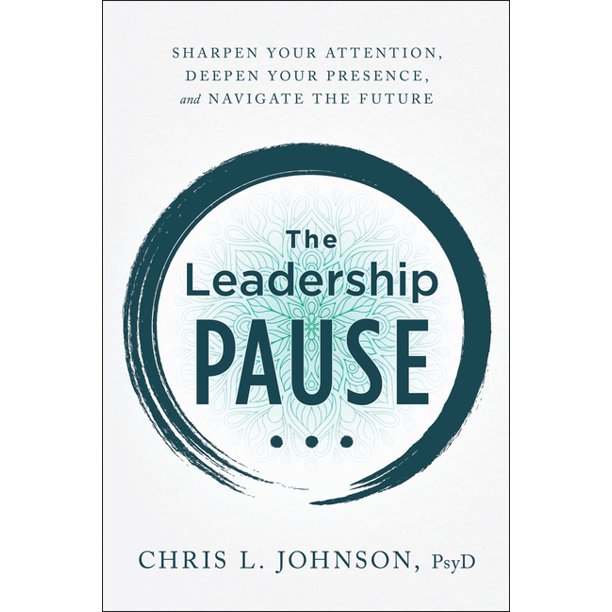
As an executive coach, I’ve read many (probably too many) books on leadership. After a while, they all seem to converge, leading the reader through the same laundry list of presentation skills, catch phrases, and power gestures that promise to show us how to inspire others to work together toward common goals. Looking back some months later, it’s often difficult for me to recall what it was exactly that distinguished any one of these leadership books from the others.
This likely won’t be the case for readers of Dr. Chris Johnson’s The Leadership Pause. Johnson’s counterintuitive argument is that it’s not what you do that makes you an effective leader but rather what you don’t do. If most leadership books are based on the law of addition – do more of this or that to become a more effective leader – Johnson’s book is based instead on the law of subtraction, in the sense that it urges us to do less by slowing down and focusing our full and undivided attention on those few moments that matter most in our professional and personal interactions with others.
In his book Why Buddhism is True, evolutionary psychologist Robert Wright argues that evolution has no interest whatsoever in facilitating our happiness as a species – its only goal is to ensure our safety and security so that we can live long enough “to get our genes into the next generation.” In fact, it is this obsession with safety and security that makes it impossible for us to achieve any kind of long-term happiness or meaning in life – or, one might add, that makes it impossible for us to lead others effectively. This argument lies at the very heart of The Leadership Pause.
Johnson writes that when leaders are struggling with the stressors of modern social, economic, and political life, their bodies react in exactly the same way that our ancestors’ bodies did when they were trying to escape the claws of a sabretooth tiger. Our brains, as highly evolved as they are, cannot yet distinguish between a physical and a social threat, with the result that our bodies react to a social threat as if our very lives were at stake.
The only way to prevent us from reacting (usually, in unskillful ways) out of these deeply held biologically and socially conditioned habits is to interrupt the operation of our sympathetic nervous system, which drives us to fight or flee in reaction to a perceived threat. As the title of Johnson’s book suggests, the best way for leaders to avoid falling victim to what Daniel Goleman calls an “amygdala hijack” is by taking a few seconds to pause, step back from the event that has triggered our emotional response, and reflect on other ways we might respond to the situation that would create less stress and therefore cause less damage to our social surround. It is only by becoming what meditation teacher Jack Kornfield describes as “a wise observer of our own experience” that we are able to transcend our bad habits. Simple to say, but not so easy to practice.
How do we actually change our behavior to become more intentional, thoughtful leaders? Johnson argues that key to incorporating periodic pauses into our daily routines is the rigorous discipline of deliberate practice, a methodology for building expertise through the guided repetition of skills that push us to the very edge of our zone of competence. Extensive research shows that this is how we learn and grow as individuals into adulthood. As Johnson observes, it is also how we grow and develop as leaders.
The Leadership Pause has a lot to recommend it. It offers a number of simple exercises for helping leaders avoid what most often gets them into trouble in their organizations because of their bad behavior. Johnson writes with extraordinary clarity and grace, and her leadership voice is in large part a consequence of her long practice of the martial art of aikido and her extensive training as a clinical psychologist. I highly recommend this book to those of us who would like to lead with greater impact and to those of us who coach others toward achieving this same ambition.
 Fridman Associates